Every buyer under contract in Houston eventually opens a PDF that mentions "evidence of foundation movement." The phrase lands like a verdict. It is not. In a market that has drifted back toward balance, with active listings up 2.1% to 38,839 homes and months of inventory at 5.2 in June 2026 and days on market climbing to 52, that same paragraph in an inspection report is often the most useful piece of leverage a buyer has all year. The question is not whether the report will flag foundation and drainage items. On a Houston slab, it almost always will. The question is which flags matter, which are cosmetic, and how the current market lets you translate them into a credit at closing.
The Soil Story Every Buyer Should Understand Once, Then Stop Talking About
Houston sits on reactive clay. The soil consists largely of montmorillonite clay, which expands significantly when wet and shrinks dramatically when dry. That single fact drives almost every structural note you will read in a local inspection. After a wet spring, the region's Vertisols and Houston Black Clay formations dry rapidly under summer temperatures. As saturated clay loses moisture, it can shrink by 30 to 40 percent, contracting and pulling away from foundations that were lifted by spring rains. This rapid swing from swollen to shrunken soil creates the exact conditions that trigger foundation movement across thousands of local homes.
Two consequences follow. First, in the Houston area, almost all foundations are slab on grade, and some sort of foundation settlement is common to almost 100% of the houses in the Houston area. Second, an inspector who writes "no evidence of movement" on a thirty-year-old slab is not being thorough. They are being careless. What you want is an inspector who separates ordinary seasonal behavior from active structural failure.
Reading The Report: Which Lines Are Signals And Which Are Noise
Inspectors document the same handful of indicators. Their meaning is not equal.
- Vertical hairline cracks in the slab or exterior brick. Not all cracks are created equal. Vertical cracks are often the least worrisome, usually caused by the natural curing and settling of concrete. These are monitor-and-move-on items.
- Stair-step brick cracks and diagonal drywall cracks from door and window corners. Horizontal cracks indicate serious pressure issues, stair-step patterns in brick or block walls, cracks wider than a quarter inch, and cracks that are actively growing deserve a structural engineer's opinion before your option period expires.
- Doors that swing open on their own, gaps at baseboards, sloping floors. Doors that swing open or close by themselves, doors that seem to be hung crooked and will not shut properly, place a round marble or ball bearing on the floor and see if it rolls or place a level on the floor to determine if the floor is level. A half-inch of slope across a room is a real number to bring to the negotiating table.
- Post-tension cable ends visible at the slab perimeter. The cables are often exposed at the foundation. They should be covered with a concrete mud from rusting out. As they rust, the cables will expand and cause the foundation to crack. An easy repair now. An expensive one later.
- Efflorescence, musty odors, moisture readings in slab. Plumbing leaks can exacerbate foundation problems in Houston. When pipes leak beneath your foundation, the water can saturate the clay soil, causing it to expand and put additional pressure on your foundation. It can also wash away soil, creating voids that lead to settlement. Ask for a hydrostatic plumbing test before you decide the foundation itself is the problem.
Most reports flag items from lines one and two. Buyers panic about line one and ignore line five, which is usually the more expensive finding.
The Item That Costs More Than Any Crack: Drainage
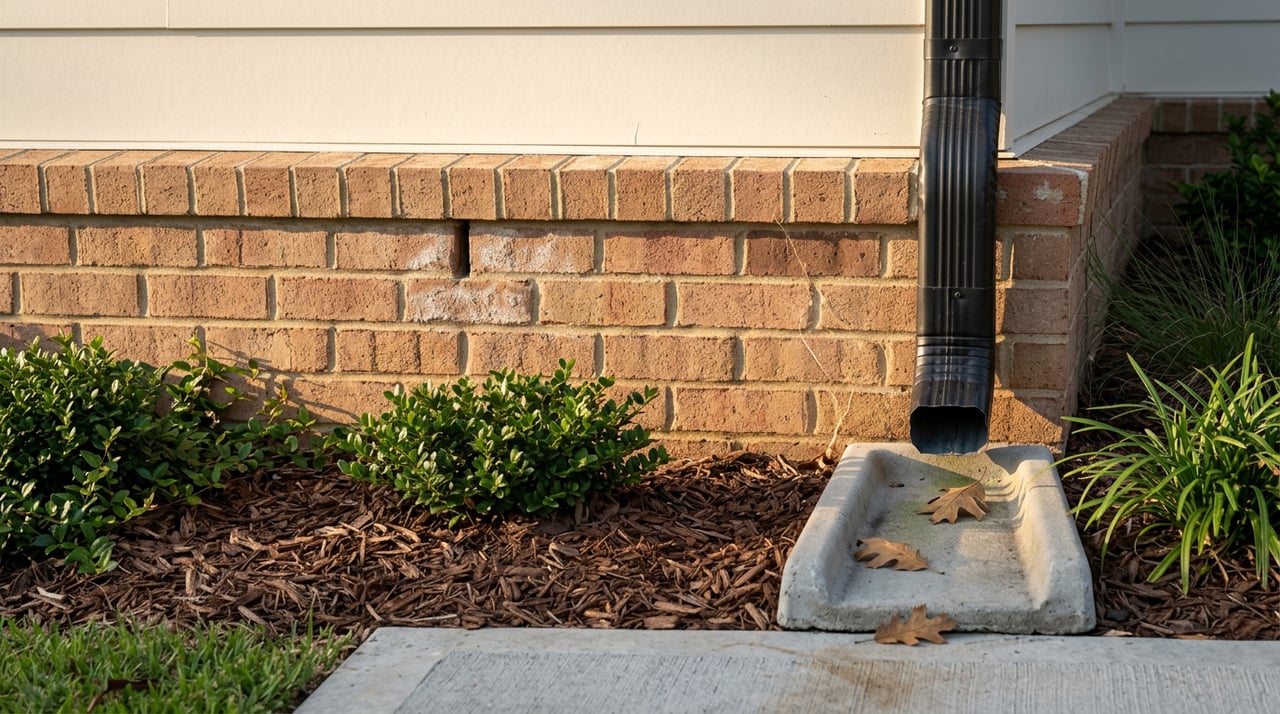
Drainage is where the transaction actually gets decided. Water should move away from the house. When grading sends water toward the slab, or when low spots collect water near the foundation, the home can face long-term moisture problems. The Gold Medal Inspections team documented a Porter property this year where a large-lot inspection found poor grading that allowed water to collect against the slab. The seller re-graded the yard before closing. That repair helped reduce a known risk before the buyer took ownership.
That is the pattern to remember. Grading and downspout direction are cheap to correct before closing and nearly impossible to force after. If your inspector flags negative slope toward the slab, that is a repair request, not an information item.
Repair Vocabulary, Translated
When an inspection recommends a foundation specialist, you will hear four methods. The vocabulary matters because sellers and their agents will sometimes propose the cheapest option as though it addresses the reported issue.
| Method | What it actually does | When it fits |
|---|---|---|
| Slab jacking / mudjacking | Injects material under settled concrete to lift it back | Slab jacking to raise settled concrete, mudjacking for minor settling — driveways, patios, small interior settlement |
| Steel piers | Driven to bearing depth to permanently support the slab | Steel pier installation for permanent support — active perimeter settlement on interior-loop homes |
| Helical piers | Screwed piers for deeper stabilization | Helical piers for deep foundation stabilization — deeper clay profiles, add-on rooms, garages |
The specific method depends on the foundation type, soil conditions, and damage extent. A seller offering a mudjacking credit for a home that needs perimeter piers is not making a serious offer.
Why 2026 Is A Better Year To Ask For A Credit Than 2022 Was
Here is the market piece most buyers miss. Inspection credits track inventory. In a two-month-of-supply market, sellers hold the pen. In a five-month market, buyers do. Single-family inventory jumped 22% to 5.6 months in June 2026, the closest this market has come to fully balanced territory in years. That statistic is not decorative. It is the reason your option period leverage looks different than it did a few years ago.
A concrete example from a 2026 Porter inspection: One property we inspected this year looked charming from the outside and sat on several acres. The roof was near end of life. With clear photos and inspection findings in hand, the buyer negotiated a $14,000 credit. Foundation and drainage findings behave the same way. In a market where the median price edged down 0.6% to $348,000 and buyers have time to walk, a well-documented report with photos and severity language becomes a bid to reprice the deal, not a request to kill it.
The corollary for sellers is direct. Grading, downspouts, and a pre-listing plumbing camera scope are the three items most likely to be flagged and the three easiest to resolve on your own timeline instead of the buyer's.
"Spring rains lift a foundation, then summer heat drops it back down, and that back-and-forth is what does the real damage." — Aaron Lipman, Two Brothers Foundation Repair
What Sellers In Houston Should Do Before Listing
If you are listing this summer or fall, a few pre-emptive moves change the tone of the inspection response entirely.
- Walk the perimeter after a heavy rain. If water pools within three feet of the slab, correct the grading before the sign goes in the yard.
- Have a plumber run a static test on the drain lines. A clean report neutralizes the most expensive suspicion buyers can raise.
- Photograph any existing foundation repairs and locate the transferable warranty. Warranties on prior repair work are often lifetime and transferable, and that documentation defuses the negotiation before it starts.
- Fix cosmetic drywall cracks only after grading and plumbing are handled. Painting over the symptom before addressing the cause reads as concealment in the report.
Texas sellers complete a Seller's Disclosure Notice as part of the transaction. Prior foundation work belongs on it. A documented, warranted repair is a stronger position than a hidden one that surfaces during the buyer's inspection.
FAQ
Does foundation movement mean the deal is dead? Rarely. It means an engineer's letter, a repair bid, and a credit conversation. In a market with months of inventory at 5.2, most sellers would rather adjust price than restart the listing at 52-plus days on market.
Should I get a separate foundation inspection or trust the general report? If the general inspector flags any structural indicator, order a foundation-specific evaluation with elevation readings before the option period ends. A licensed inspector conducts a detailed evaluation focused on early and advanced signs of foundation movement, including floor elevation readings using professional leveling equipment.
Are new-construction homes safe from these issues? No. Recently built homes can experience movement if the soil hasn't fully settled or if grading was rushed during construction. Ask the builder for the pre-pour foundation report and schedule an eleven-month warranty inspection before that window closes.
Is a post-tension slab better than a conventional slab? Post-tension slabs are used to help alleviate some of the problems that result from a settling foundation. A post-tension slab has cables that are put under very high tension which helps to hold the slab together. With a post-tension slab, the whole slab moves or tilts as a solid piece. It is more forgiving of clay movement, but it still needs proper drainage to perform.
Every Houston transaction eventually meets the clay. The buyers and sellers who close cleanly are the ones who read the report as a document to work from, not a document to fear. If you are preparing to buy or list this season and want a walk-through of the specific inspection items likely to surface on your property, Urban Access Properties is here to help. Schedule a free consultation and we will map the negotiation before the report ever arrives.